
The Cost of This Job
We don't post flat prices here because a torsion spring job and a full door replacement aren't the same call, and quoting one number for both would be a lie either way. What we can tell you is how Culver City differs from the rest of the area we cover. Median household income here is $122,312, well above the $83,538 median across the wider service area. In practice that shows up as a different kind of decision at the door: more Culver City customers ask us to replace an opener outright rather than nurse a failing gear along, and more ask about upgrading to a quieter belt-drive unit instead of just swapping in another chain drive to match what's there. That's a customer preference, not a discount or a surcharge tied to the town, and we quote every job the same way regardless of the address. The other number worth knowing is distance. Culver City sits about 6 miles from our shop in Santa Monica, so a call here means a short crosstown drive, not a walk-around-the-corner dispatch. That doesn't change what we charge for parts or labor, but it's a factor in how we schedule the day.
Why This Fails Locally
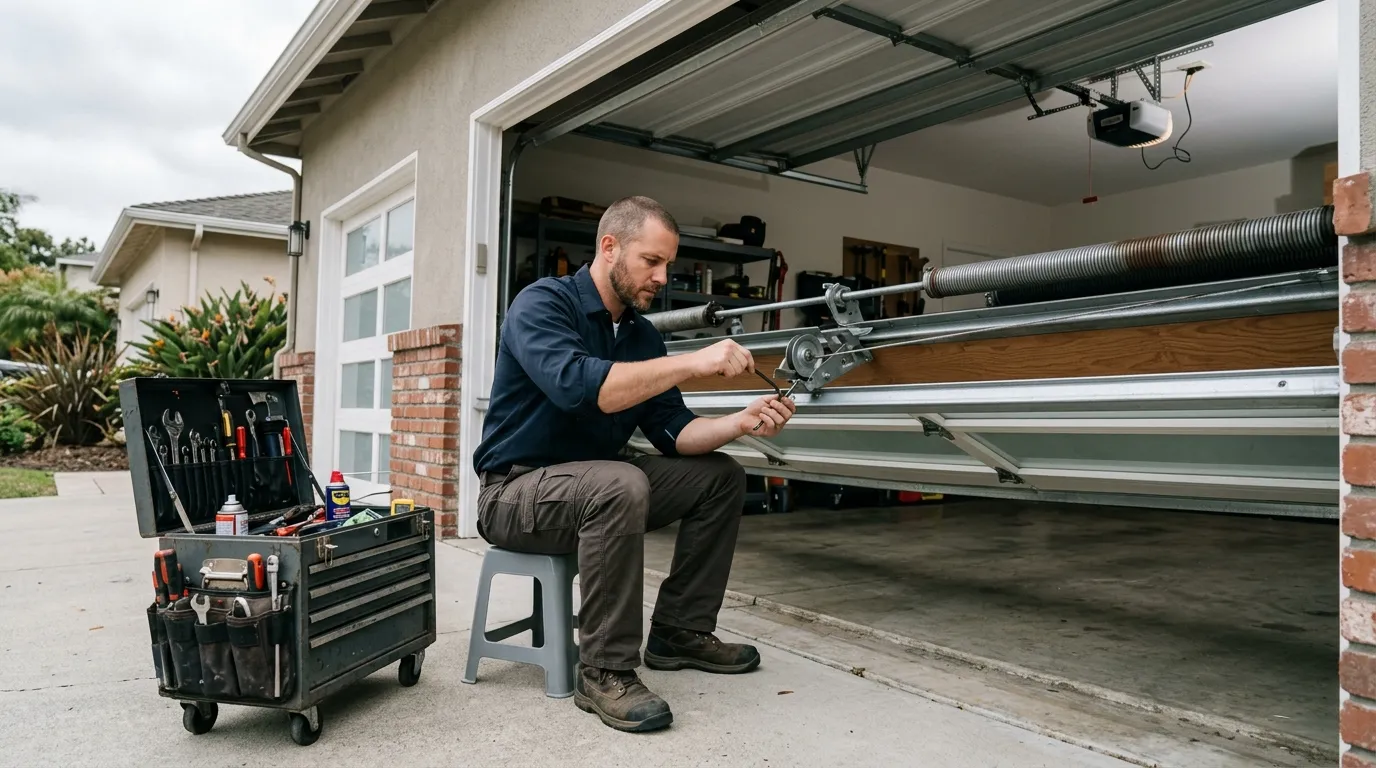
The climate here is mild temperate, which is a mixed blessing for a garage door. There's no freeze-thaw cycle tearing at weatherstripping and no heavy seasonal humidity swing warping wood panels, so the springs and tracks on a Culver City door usually fail from cycle count and age rather than from weather damage. That's the upside of F3's mild band. The failure mode we actually see tied to the local numbers is different: with median household income well above the area average, more Culver City garages carry two vehicles and get used daily, sometimes multiple times a day, which runs up the cycle count on a torsion spring faster than a door that only opens on trash day. A spring rated for roughly 10,000 cycles doesn't care what the house is worth; it cares how many times it's been asked to lift the door. Combine that with a housing stock centered on 1962 and you get a specific, predictable failure: original-era torsion springs nearing or past their cycle life, on doors that are otherwise in decent shape because the mild climate never worked against them.
The Complications
Culver City accounts for roughly 17,740 households inside a service area of 394,216, a small, dense slice of mostly 1960s tract construction. That density matters for one practical reason: a lot of these garages sit close together on similar-sized lots, so when one door on a block needs a part, the neighbor's often needs the same part not long after. It's a small edge for us in stocking common torsion spring sizes for this era, but it's not a guarantee. Here's the honest limit: some of the odder panel widths and older extension-spring setups from the early 1960s aren't parts we keep on the truck, and if a door needs one of those, there's a lead time on ordering it - sometimes a few days, not a same-visit fix. We'll tell you that on the spot rather than stall you with a vague timeline. On a door that old, we'll also tell you straight when a repair isn't worth it against the cost of replacing the whole unit, rather than patch something that's going to fail again in a year.